
Balcony Gardens for NCR Flats 2026 — 10 Air-Purifying Plants That Actually Survive Delhi's AQI 300+ Winters
Ten indoor plants that genuinely clean the air and tolerate NCR's AQI-300 winters, plus the soil mix, watering discipline, and vertical-garden setup that makes them survive beyond month three.
Delhi's AQI hit 226 in the "Poor" category on 16 April 2026 and GRAP Stage-I restrictions were back on the city by lunch. If the April number reads like that, the November-February number will again be what we're now used to — AQI 350+, air you can taste, eyes that water by 9 pm.
Plants are not a solution to that. A HEPA purifier is. But plants are the background layer — they take roughly 10-15% off VOCs and particulates, they regulate humidity, they give a compromised Delhi flat the one thing concrete and aluminium never will: a living surface that reacts to the morning light. The question is which plants actually survive an NCR year, and which die dramatic deaths by month four.
Here are the ten that make it through.
The ten survivors for NCR balconies and interiors
1. Snake plant (Sansevieria trifasciata)
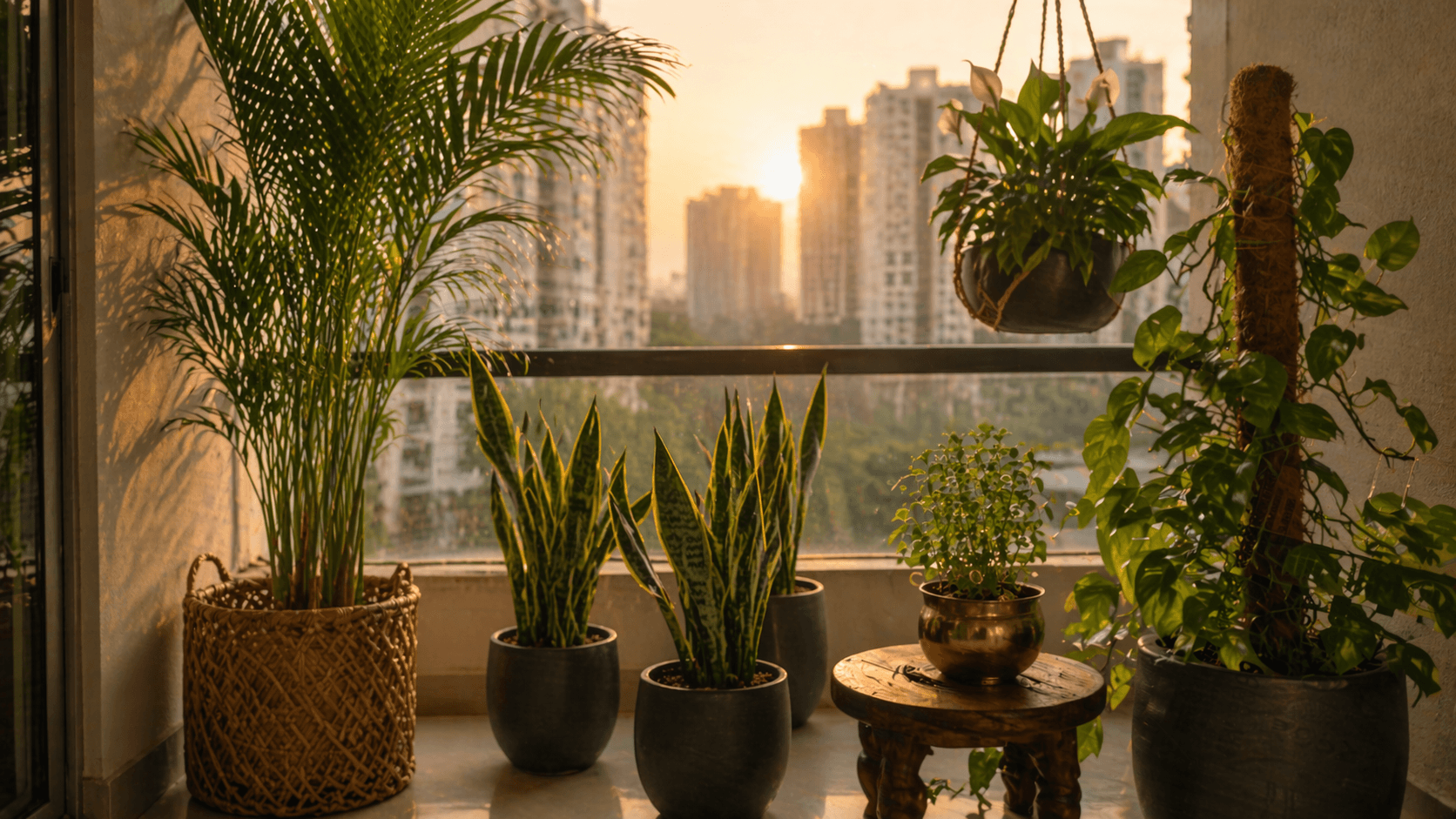
The most forgiving plant in the entire list and the only one we'd recommend for a bedroom. Snake plant releases oxygen at night (CAM photosynthesis), filters formaldehyde and xylene, and survives six weeks of neglect. Tolerates west and south-facing NCR balconies where direct afternoon sun roasts everything else. Water every 14-21 days in summer, once a month in winter.
2. Areca palm (Dypsis lutescens)
Transpires approximately one litre of moisture a day, which makes it the single best natural humidifier for Delhi's arid November-February stretch. Needs bright indirect light (ideal: 2-3 m inside an east-facing balcony door). Prone to spider mites in summer — wipe the fronds monthly with a damp cloth. Expect a mature 5-ft areca to cost ₹800-1,800 in NCR nurseries.
3. Money plant (Epipremnum aureum, the golden variant)
The plant that refuses to die. Filters benzene, formaldehyde and CO. Grows in water, in soil, hanging, climbing, in full shade, in bright indirect light. The only way to kill a money plant is to overwater it in a pot without drainage.
4. Peace lily (Spathiphyllum wallisii)
Best in the list for NO2 and benzene removal — relevant for NCR balconies that look onto arterial roads. Blooms white spathes twice a year if it's happy. Wants filtered sun (north-facing balconies, or east-facing with a sheer curtain). Droops theatrically when thirsty, rebounds within hours of watering — excellent plant for learning the watering rhythm.
5. Spider plant (Chlorophytum comosum)
Removes formaldehyde and xylene, tolerates fluorescent-tube office lighting, and produces "baby" plantlets on runners that you can snip off and plant in new pots. The easiest plant to propagate, period. Great for a hanging basket near a kitchen window.
6. Aloe vera
Filters benzene and formaldehyde. Thrives on NCR's dry heat — do not over-love it. Water every 3 weeks in summer, monthly in winter. Bonus: the gel is useful for minor burns in the kitchen, which is why it belongs on a kitchen windowsill rather than the living room.
7. Rubber plant (Ficus elastica)
Broad glossy leaves that trap particulate matter (the literal dust-collector of air-purification). Filters formaldehyde. Tolerates moderate light. Wipe the leaves monthly with a damp cloth — dust-coated leaves stop working. Grows quickly; expect to repot every 18-24 months.
8. Boston fern (Nephrolepis exaltata)
The best humidifier in the list after the areca palm. Filters formaldehyde and xylene. Needs high humidity — it will sulk in a dry Delhi January unless you mist it twice a week or put it next to the areca. Best for a bathroom with a window, a shaded north-facing balcony, or a kitchen that gets morning steam.
9. Golden pothos (Epipremnum aureum, the marbled variant)
Functionally similar to money plant but with variegated gold-and-green leaves. Climbs a moss pole beautifully. One of the few plants that genuinely thrives in low light — ideal for the dim corner of a Noida flat's inner room.
10. Tulsi (Ocimum sanctum)
The cultural plant most NCR households already have. It filters benzene, ozone and formaldehyde, and it is specifically tolerant of Delhi's mixed temperature swings. Keep it in a brass or terracotta pot in an east-facing spot. Water daily in summer, alternate days in winter. Pinch the tops regularly to encourage bushy growth. Replace the plant every 18-24 months as it goes woody.
Soil mix that actually works in NCR
Most balcony plants die not from AQI or light but from Delhi's heavy clay soil. Here's the mix every serious urban gardener in Noida and Ghaziabad ends up at:
- 2 parts cocopeat (aerates, holds moisture)
- 1 part vermicompost (nutrients, slow-release)
- 1 part sand (drainage, prevents compaction)
- A handful of neem cake per pot (natural pest control against mealybugs and spider mites)
Repot every 18 months. NCR summers cook the soil, and cocopeat breaks down faster here than in coastal climates. Fresh soil every year and a half is the difference between a rubber plant that triples in size and one that plateaus.
Watering discipline — the single biggest killer
Overwatering kills more NCR plants than pollution, sun, or pests combined. The cold-humid mornings of January plus clay-compacted soil create root rot in three weeks flat.
- Summer (April-June): morning watering, before 9 am. Soil should feel dry 1 inch down before you water.
- Monsoon (July-September): balcony plants under a sun-shade can go a full week without watering. Check before pouring.
- Winter (November-February): afternoon watering only, on sunny days. Plants drink less in cold — reduce frequency by 40-50%.
- GRAP dust-fall days: hose down the leaves gently with a spray bottle to wash off settled PM2.5. Dust-coated leaves photosynthesise poorly and look sad.
Vertical gardens — the 40-plants-in-1-sqm trick
For compact NCR balconies (2 BHK and studio flats), a vertical garden tower is the single biggest footprint multiplier. The Nova 40 category (and copy-cats at ₹6,500-12,000) lets you grow 40+ plants — mostly herbs and small leafy greens, but also pothos and spider plants — in roughly one square metre of floor space.
Grow bags are the cheaper and more flexible alternative: 40% lighter than ceramic pots, better drainage, and ₹80-200 per bag. A row of six grow-bags along the balcony parapet gives you a visible green wall without drilling into the structure. Budget landlords and rental tenants — this is your path.
Combine with a HEPA purifier (honestly)
Plants do around 10-15% of the particulate-filtration work. A HEPA purifier rated at 300-500 CADR (Clean Air Delivery Rate) does the other 85%. If you're spending ₹6,000-12,000 on a vertical garden to improve indoor air, also spend ₹15,000-40,000 on a purifier. The combination is what moves PM2.5 from unsafe to safe overnight — plants alone will not.
Mistakes to avoid
- Don't put full-sun plants on a shaded north-facing balcony. Money plants, snake plants, peace lilies, pothos, and Boston fern all like shade-to-filtered light. Aloe, tulsi, rubber plant, and spider plant want bright light. Match the plant to the direction; swapping one shaves months off lifespan.
- Don't water on a schedule. Water on a moisture-reading. Poke a finger one inch into the soil — if it's dry, water; if damp, wait.
- Don't use ceramic pots without drainage holes. Root rot will kill the plant in six weeks. Always drainage, always.
- Don't ignore the pests. Spider mites, mealybugs and scale insects are endemic in NCR summers. Neem oil spray (5 ml in 1 L water) once a fortnight keeps them in check. Waiting until you see them means you're already two generations behind.
- Don't expect plants to replace a purifier during GRAP Stage 3-4. When AQI hits 350+, seal the windows and run HEPA. The plants are background decor then, not first-line defence.
- Don't over-fertilise. A teaspoon of vermicompost mixed into the top inch of soil every two months is enough. Most balcony plants die of fertiliser burn, not undernutrition.
What we'd set up for a 2 BHK Indirapuram flat
- Living room: 1 areca palm (humidifier + statement), 1 rubber plant in a charcoal pot, 1 peace lily on a shelf, 1 money plant climbing a moss pole on a corner table.
- Master bedroom: 1 snake plant on the bedside (night oxygen).
- Kitchen windowsill: 1 aloe vera, 1 tulsi in a brass pot.
- Balcony (east-facing): vertical tower with basil, mint, curry leaves, and cilantro on the lower tiers; pothos and spider plant on the upper tiers.
- Budget: roughly ₹4,500-7,000 for the full setup including pots, soil mix, and the vertical tower.
If you'd like a balcony-garden plan mapped to your flat's orientation — or a broader interior-plant spec alongside interior design — call us or send a brief with your flat's directions and light conditions. We'll come back with a plant list and sourcing shortlist within 48 hours.
For related reading, see our interior design budget guide for NCR, the Indirapuram investment primer, and current properties we're tracking if you're still flat-hunting.
— Team 9 Property Wala