
Modular Kitchen Trends 2026 for NCR Homes — Handle-less Fronts, Waterfall Islands and the End of the Overhead Loft
The modular-kitchen design language that's actually being built in NCR in 2026 — handle-less shutters, waterfall quartz islands, tall pantry units, integrated appliances, warm earth palettes.
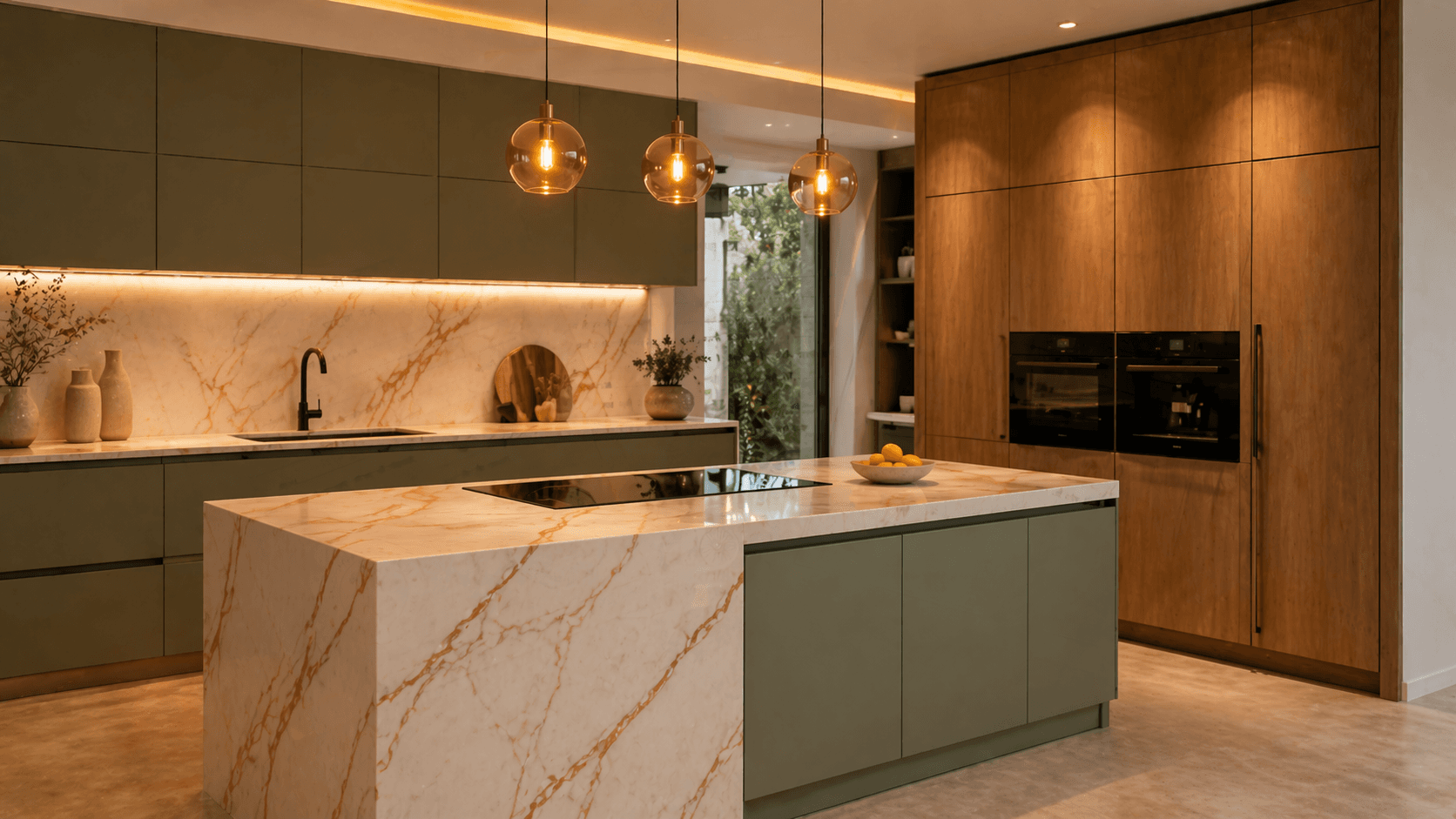
The kitchen is the one room in the flat where design fashion actually meets daily use. A misjudged trend here doesn't just look dated in five years, it slows down every meal for a decade. So when we say certain looks are now standard in 2026 NCR kitchens, it's because they've survived the test of the tadka — they still work the morning after.
Here is what the studios in Indirapuram, Noida and Gurgaon are actually building this year, and the handful of trends that are worth the premium.
Handle-less shutters are the new default
The clearest visual shift in 2026 is the disappearance of handles. Push-to-open mechanisms and J-profile shutters (a subtle recess at the top edge that acts as a handle) now dominate new-build kitchens across every price band above economy.
Why it stuck:
- Cleaner front elevation — the cabinet reads as a single plane, which makes small NCR kitchens feel larger.
- Easier to clean — nothing for haldi-stained fingers to get caught on.
- Child-safe and sari-safe — no hardware snags.
- Quietly more expensive only at the top end; J-profile is now a ₹400-600/sqft add-on, not a luxury spec.
The compromise: push-to-open loses tactile precision after 3-4 years of heavy use. For the most-opened drawer (under the hob, typically), we still specify a matte-black handle or an integrated finger-pull. Use push-to-open for the rest.
The waterfall island is the 2026 aspirational centrepiece
If you're designing a 3 BHK or larger in Sector 150, Wave City, or the luxury Indirapuram towers, the island has become the kitchen's defining gesture — and the waterfall edge (stone cascading vertically down the side) is the specific detail that signals 2026 over 2020.
What's actually being built:
- Tiered heights — a lower section (760 mm) in warm-wood veneer that becomes the dining / breakfast counter, and a higher stone-clad section (900 mm) for prep.
- Integrated induction coils hidden beneath the stone surface so the island becomes a dining table when not cooking. Brands like Kaff, Faber, and Bosch have 2026 India SKUs for this.
- Pop-up sockets flush to the stone, for plugging in a mixer-grinder without visible wall points.
- Quartz over marble — Calacatta-look quartz is the dominant 2026 choice because it resists haldi, citric acid, and hot pots in a way marble doesn't.
Budget reality: a 2.4 m waterfall island with tiered heights and integrated induction adds ₹1.8 – 3.5 L over a plain island. Worth it if your living-dining is open-plan. Skip it if you already have a separate dining room.
The overhead loft is dying — tall pantry units are replacing it
This is the single most useful 2026 shift. The traditional Indian kitchen had a loft above the wall units — the place where the pressure cooker extras, annual festival utensils, and forgotten mixer attachments went to collect dust.
In 2026 NCR kitchens, the loft is being replaced by floor-to-ceiling tall pantry units (2.4 m height). What you gain:
- Real storage at reachable heights — no stool required.
- Cleaner visual — continuous vertical grain instead of a broken wall-loft-ceiling line.
- Hidden appliances — the oven, microwave, and sometimes a built-in coffee machine live behind one tall pantry door.
- Roll-out shelves that bring every atta dabba and masala jar into direct sight.
In lower-ceiling NCR flats (typical slab-to-slab 2.9-3.1 m), the tall pantry reads as a wardrobe-next-to-kitchen, which is visually calming compared to the busy three-tier wall we grew up with.
Matte, satin and textured stone — the end of high-gloss
High-gloss acrylic had its moment between 2018 and 2023 and is now on its way out in NCR premium builds. The 2026 palette is matte and satin.
- Matte laminate shutters — Merino, Greenlam, Century Laminates all have 2026 ranges in sage, terracotta, charcoal and oat. Fingerprints don't read; scratches don't glint.
- Satin PU at the luxury end — same visual softness but repairable.
- Fluted / grooved quartz for the backsplash — vertical micro-grooves that catch under-cabinet lighting and turn the back wall into a texture feature.
- Textured stone islands — bush-hammered edges on quartz add a tactile element that photographs beautifully without being impractical.
If your interior designer is still pushing gloss white laminate in 2026, ask how long they've been running their studio. The smart ones pivoted two years ago.
Integrated appliances are now a mid-budget spec
Integrated appliances used to mean "luxury only". Not anymore. Brands like Bosch, Kaff, Elica, and Faber have 2026 India SKUs for:
- Built-in ovens (60 cm, ₹55,000 – 1.5 L)
- Integrated dishwashers that take a matching shutter front (₹60,000 – 1.2 L)
- Integrated chimneys hidden behind a wall-unit shutter that drops away when the hob turns on
- Wine coolers and bottle chillers for the social-entertaining crowd
Done well, the entire wall reads as continuous cabinetry — no visible appliance except the hob. Expect a 15-20% premium over free-standing equivalents, plus a bit more because the cabinet has to be built precisely to the appliance's cutout spec.
Worth doing if your kitchen opens into a living-dining. Not worth doing if your kitchen is boxed and nobody sees it.
Hardware — the quiet luxury you should actually pay for
The one place we always argue for spending more:
- Hettich Innotech Atira drawers (mid-range) or Blum Tandembox / Legrabox (premium) over unbranded Chinese hinges and channels.
- Blum Aventos or Hettich Senso flap-lift systems on overhead cabinets — soft-close, held-open at any angle.
- Magic corners (swing-out blind-corner mechanisms) — pair of brackets ₹8,000-18,000 but recovers 25% of dead corner space.
- Bottle pull-outs next to the hob — ₹4,500-8,000 each, now near-universal in mid-budget builds.
- Tandem drawer systems with integrated dividers — the line where a ₹1.5 L kitchen starts feeling like a ₹4 L kitchen.
The shutter finish wears out first; the hardware wears out last. Cheap hardware is what ruins a kitchen at year six.
Colour palette 2026: warm earth is winning
The cool-grey modular kitchen of 2020 is being replaced by warm earth tones in NCR 2026:
- Terracotta, rust, burnt ochre (usually as the island accent against neutral wall units)
- Sage green, olive, muted forest
- Mustard and honey (particularly in Gurgaon villa kitchens)
- Walnut and oak veneers returning at the high-end as an alternative to full-laminate builds
Cool-grey and crisp-white are still the default for compact 2 BHK kitchens where the goal is to make a small room read large. Everywhere else, warmth is back.
Sustainability: BWR ply is being questioned at the top end
At the luxury end of 2026 NCR builds (Sector 150 branded-luxury, DLF Camellias-tier Gurgaon, select Indirapuram penthouses), BWR plywood is being quietly replaced by:
- FSC-certified boarding (Forest Stewardship Council) — plywood and MDF sourced from certified forests.
- Aluminium-frame cabinets in the most expensive 2026 kitchens — zero off-gassing, fire-resistant, lasts 30 years but costs 2x.
- Water-based PU finishes replacing solvent-based — lower VOC, mandatory for any IGBC-certified tower.
Economy and average-band builds aren't there yet and likely won't be for another 2-3 years. If your project is chasing IGBC Gold, ask your interior designer for FSC documentation up front.
Mistakes to avoid
- Don't design the island before the layout is final. An island needs 90-100 cm clearance on every side to work; many 2 BHK NCR kitchens simply can't carry one honestly. Forcing it creates traffic jams during real cooking.
- Don't spec integrated appliances without confirming model availability. Some 2026 European SKUs have 10-14 week lead times. Pick appliances first, then design cabinets around them.
- Don't fall for the "Italian kitchen" sticker on locally-manufactured carcass. Shutters may be imported; the box behind them is usually Indian MDF. That's fine — just don't pay Italian prices for it.
- Don't skip the under-cabinet lighting. It's ₹8,000-15,000 of LED strip that transforms every photograph and every late-night sandwich. The single best money-for-impact line item in the kitchen.
- Don't pick a hood that's smaller than the hob. 90 cm hob + 60 cm chimney is a recipe for an oily ceiling. Chimney width should always equal or exceed hob width.
What we actually recommend
For an average-band 3 BHK kitchen in NCR 2026: matte-laminate handle-less shutters (J-profile), Hettich Innotech Atira hardware throughout, quartz counter, tall pantry unit replacing the wall loft, one veneer accent (usually the tall pantry door), integrated chimney + free-standing hob + free-standing oven, matte-black hardware for the hob drawer. That lands at roughly ₹3.8 – 5.5 L for an L-shaped 8x10 kitchen — tasteful, quiet, and still looks correct in 2031.
If you'd like a specific kitchen scoped against your floor plan — call us or send a brief. We'll come back with a 3D render, itemised spec, and two shutter-finish options within 48 hours.
For related reading, see our interior design budget guide for NCR 2026, the Indirapuram investment primer, and current properties we're tracking if you're still looking at the flat.
— Team 9 Property Wala