
The Namo Bharat RRTS Effect — 7 NCR Micro-Markets the 82-km Delhi-Meerut Rapid Rail Will Re-Rate by 2028
The Namo Bharat corridor is fully commissioned. Here's which 7 NCR micro-markets are already pricing in the re-rate — and which ones still have room to run.
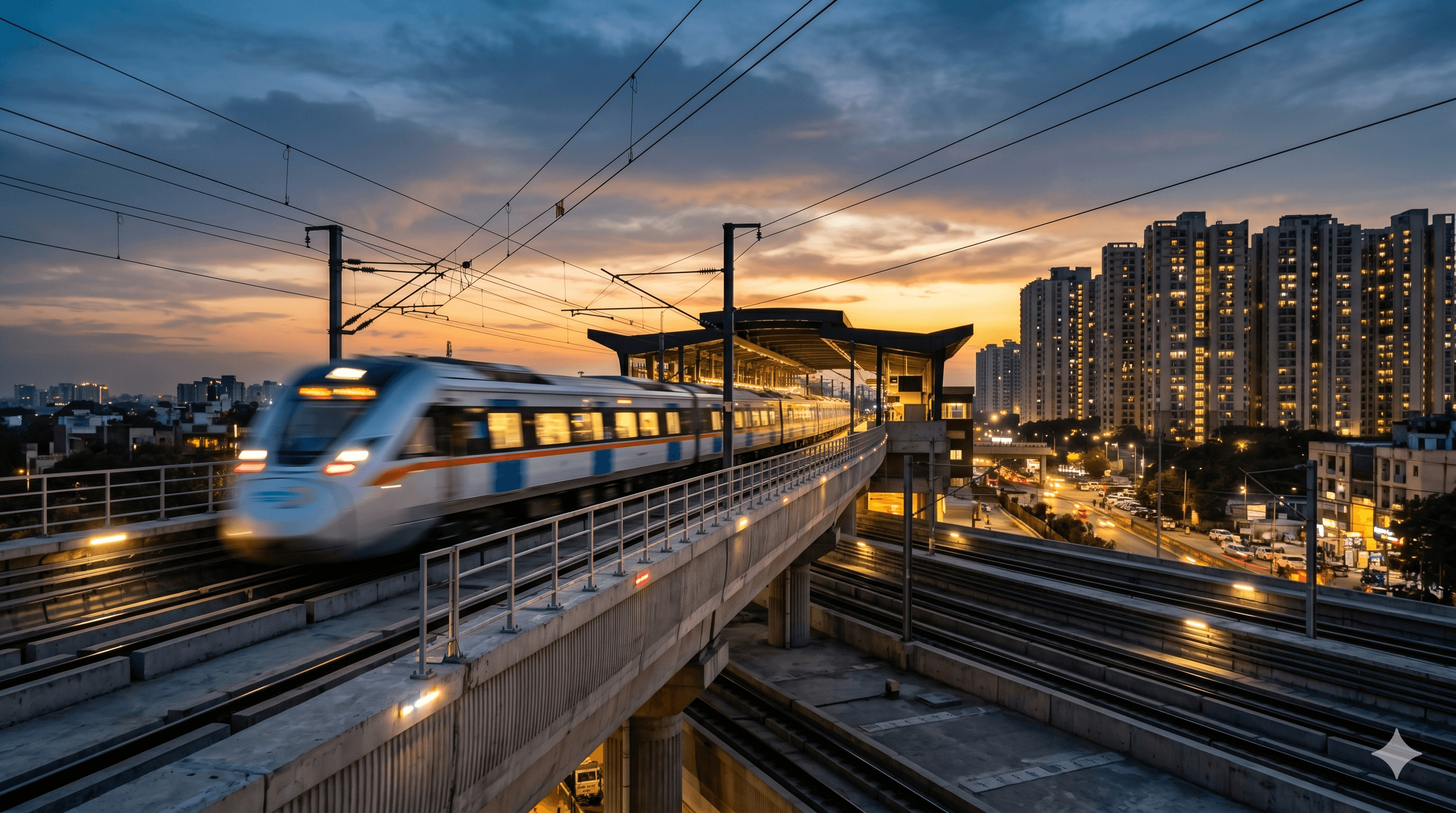
The Delhi-Meerut Namo Bharat corridor hit full commissioning in February 2026 — 82 km, Sarai Kale Khan to Modipuram, end-to-end in under 60 minutes at a 180 km/h design speed. The property-market reaction is not a forecast any more; it's a live re-rating you can measure. This piece sorts seven NCR micro-markets into what's already moved, what's moving now, and what the patient buyer should watch.
The Corridor, Stripped to What Matters
NCRTC delivered the project for roughly ₹33,000 Cr. The nine stations on the Ghaziabad stretch are Sahibabad, Ghaziabad (New Bus Adda), Guldhar, Duhai, Duhai Depot, Murad Nagar, Modi Nagar South, Modi Nagar North and Meerut South. For property pricing, station proximity inside 2 km of a working stop is where the halo premium shows up cleanly. Beyond 2 km it fades fast.
The headline commute numbers:
| From | To | Time |
|---|---|---|
| Sahibabad | Anand Vihar (Delhi) | ~17 min |
| Sahibabad | Meerut South | ~35 min |
| Ghaziabad New Bus Adda | Sarai Kale Khan | ~28 min |
| Modi Nagar North | Sarai Kale Khan | ~42 min |
Those numbers are what converts a theoretical infrastructure project into a real household decision — because a Meerut-based professional can now live in a ₹60 L plot-built floor and commute to Anand Vihar in under an hour door-to-door. That wasn't possible two years ago.
Band 1 — Already Benefiting (The Premium Is Priced In)
Indirapuram and Vaishali
Sahibabad station sits as Indirapuram's northern gateway — a 10-minute drive from most Ahinsa Khand and Shakti Khand societies. Vaishali goes one better by being walking-to-rickshaw distance for several sectors.
What we're seeing on the ground:
- Vaishali flats are quoting ₹8,600-12,950 per sqft in the 2026 99acres data, with corner-tower units near the metro/RRTS axis commanding the upper band
- Brokers in Ahinsa Khand and Shakti Khand within 2 km of Sahibabad are quoting a 6-10% "RRTS halo premium" vs comparable Indirapuram inventory further south
- Resale liquidity has tightened — homes are clearing in 4-6 weeks that previously took 3 months
The tactical read is that the re-rate is mostly done in these two pockets. You're not buying upside here; you're buying a stabilised, liquid, transit-connected asset. If that's what you want, fine. If you're hunting alpha, look at Band 2. Our full Indirapuram investment brief unpacks the sub-locality breakdown in detail.
Band 2 — Next to Benefit (The Arbitrage Window Is Open Now)
Raj Nagar Extension
RNE sits a 10-12 minute drive from Duhai and Duhai Depot stations, not a direct walk, but close enough for the halo to start pricing in. At ₹5,850-7,550 per sqft it's trading at roughly 55-65% of Vaishali's number with a shorter appreciation history. The five-year run has already been +127%, but the RRTS-specific re-rate on RNE has barely started — brokers are still quoting the station as "just a drive away" rather than as a priced feature.
Crossings Republik
This is the quietly interesting one. Crossings Republik sits 3 km from the proposed Ghaziabad South station on the Jewar-Ghaziabad RRTS line (phase 2). That gives it a dual-corridor arbitrage — it already benefits from NH-9 connectivity to Noida, and it will benefit again when the second RRTS spine commissions. Ticket sizes here are still ₹5,200-6,800 per sqft for 2 and 3 BHKs. The catch is that phase 2 is a 2028-30 event, not a 2026 event, so you need the patience for a 3-4 year holding period.
Muradnagar
Muradnagar has gone from "semi-rural town most Delhi-NCR buyers couldn't place on a map" to a station on the corridor. Land rates in walking distance of the station have gone from ₹18,000 per sqm to ₹34,000-42,000 per sqm in 18 months. Plotted inventory here is the play — not apartments, of which there aren't many credible options yet.
Band 3 — Early Catalyst (For Patient Capital Only)
Modinagar
Both Modi Nagar South and Modi Nagar North stations are operational. The market is still thin — meaning low transaction volumes, wide bid-ask spreads, and limited developer credibility. Land is the primary asset class here, with the best rates going in pockets within 1.5 km of the two stations. Expect a 4-7 year view.
Meerut South
Technically outside Ghaziabad, but strategically relevant because it's the corridor's southern Meerut endpoint and the first Meerut station the Delhi commuter reaches. Plotted land and small-format builder floors are where capital is going. The upside is real but the exit liquidity is a genuine question — secondary sales take 6-9 months routinely.
Who Should Buy Now, and Who Should Wait
Buy now
- Self-use buyers commuting to Delhi — Band 1 or the better parts of Band 2 (Crossings Republik, near-station RNE). The commute delta is life-changing and the premium is justifiable
- Rental-yield hunters — Vaishali and Sahibabad-edge Indirapuram are giving 2.6-3.2% yields with strong tenant demand from Delhi-side professionals
- Plot investors with a 4-year view — Muradnagar and Modinagar plotted inventory, but only from sellers with clean titles and no encumbrance history
Wait
- Speculators looking for the 2x flip — that window was 2023-2025 in this corridor. The halo is now partially priced, not unpriced
- First-time buyers with tight budgets — don't stretch into a Band 3 market for a "future re-rate." Live in a Band 2 asset that already works
- Anyone buying sight-unseen on broker promises — station distance varies enormously within a single sector. Measure it on Google Maps, then visit
Our Playbook for RRTS-Driven Buying in 2026-27
- Verify station walking distance yourself. "Near the station" in a listing means 10 km until you check
- Favour ready-to-move or under-6-month inventory. A 3-year delivery dilutes your re-rate capture
- In Band 1 expect to pay the premium but get the liquidity. In Band 2 expect to hunt for the remaining discount. In Band 3 expect to be patient
- Track the circle-rate notifications across Ghaziabad municipal zones — a station-area circle-rate revision is typically 15-25% and is a useful signal of official acknowledgement
- Don't confuse the announcement of a future RRTS spine with a working station. The Jewar-Ghaziabad line matters, but its re-rate arrives 2-3 years before its wheels move
If you want a station-by-station shortlist keyed to your budget and commute, get in touch. We maintain a live pipeline across all seven micro-markets — you can also browse our current listings as a starting point.