
Vaastu for 3 BHK Flats 2026 — A Practical Room-by-Room Guide for NCR Buyers Who Want Positivity Without Renovating
A practical 2026 Vaastu guide for 3 BHK flats in NCR — room directions, kitchen and pooja placement, common defects in cookie-cutter towers, and remedies that don't require knocking down walls.
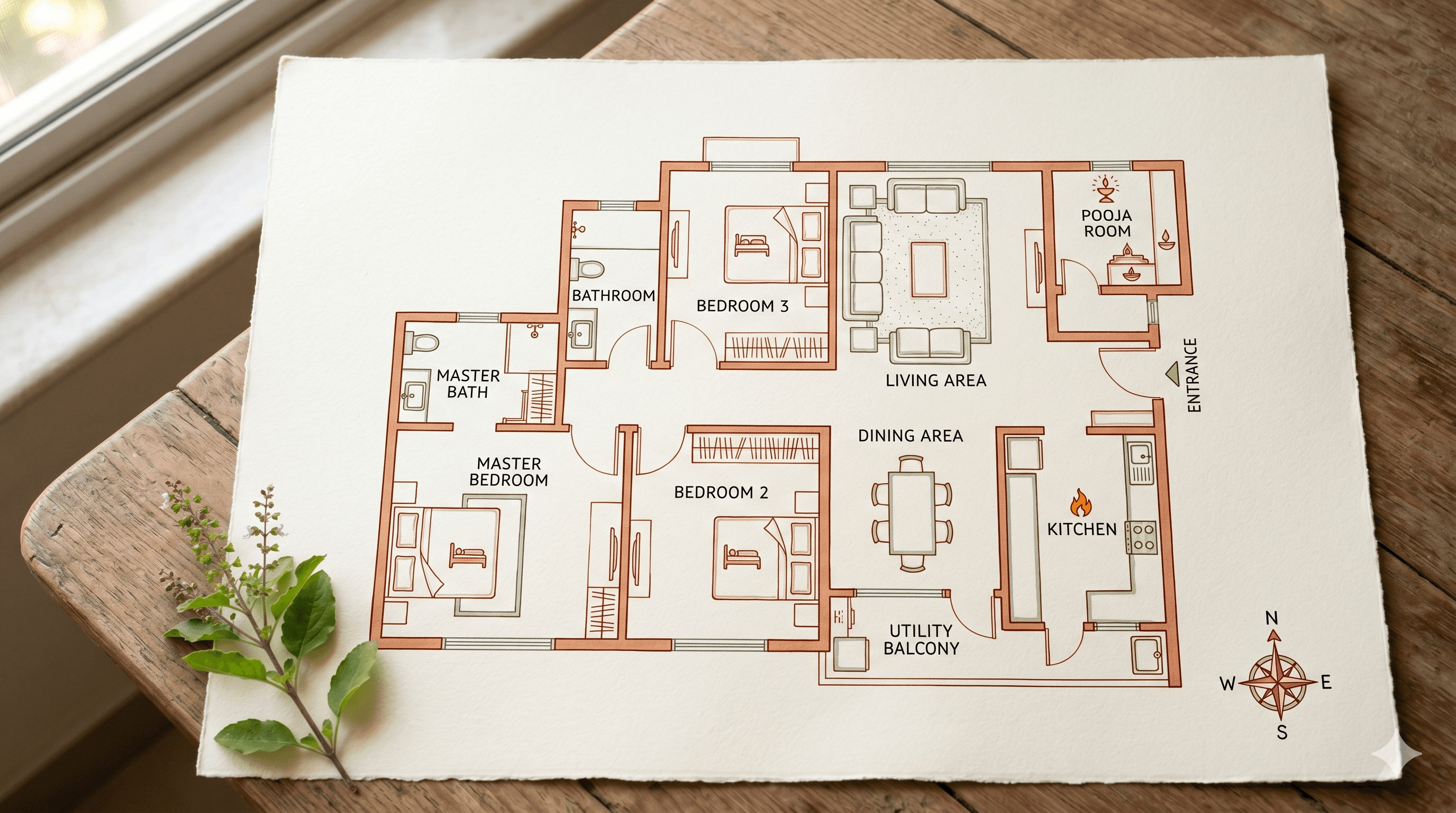
If you've shortlisted three 3 BHKs in Sector 150 or Indirapuram this month, chances are someone in the family has already asked about Vaastu. A parent, a grandparent, or your own quiet gut — the question tends to arrive the same way: "Yeh flat achha hai na? Vaastu theek hai?"
Vaastu in 2026 NCR is a conversation most buyers can't avoid even if they want to. It is also a conversation where builders, brokers and self-proclaimed consultants say wildly different things, often at the moment you most need a clear answer. This is the plain-English version — which direction belongs to which room, what NCR's cookie-cutter towers tend to get wrong, which defects actually have low-cost remedies, and which ones genuinely affect how you'll live in the flat for the next decade.
The compass before the flat
Vaastu Shastra divides the home into eight directions plus the centre, each associated with an element and a life theme. Before walking through any flat, you need two things — a compass on your phone, and the rough orientation of the entrance. Every Vaastu assessment starts from the entrance, not from the living room.
A few orientation basics that resolve 60% of confusion:
- Face outward from the main door to read the entrance direction. If you step out of the flat and your face is pointing east, it's an east-facing flat — even if the tower itself faces north.
- The "facing" is the direction you look when leaving the flat, not the direction the building complex faces
- In apartments, orientation is the direction the main door opens out to — balcony direction is secondary information, not the primary facing
- Stand in the geometric centre of the flat when placing the compass to avoid metal interference from kitchen appliances or window grilles
With that settled, the room allocations fall into place.
The room map — where each space belongs
Kitchen — south-east (Agni corner)
The kitchen belongs to the south-east, the corner of Agni (fire). This is the single most important Vaastu rule in a home because the kitchen's placement governs daily cooking energy, health, and household harmony.
- Gas stove position: cooker should be placed so that you face east while cooking
- If south-east is unavailable (common in north-east-facing flats), north-west is the acceptable alternate — never south-west or north-east
- Avoid placing the kitchen directly opposite the main door; if unavoidable, a curtain or soft screen breaks the sight-line
- Sink (water) and stove (fire) should not share the same counter if it can be helped — a 30 to 45 cm separation is ideal
Master bedroom — south-west
The south-west is the corner of stability, decision-making, and financial security. It belongs to the head of the household.
- The bed should be placed so the sleeper's head points south or west (never north)
- Avoid mirrors directly facing the bed — where unavoidable, cover them at night
- A wardrobe or heavy storage along the south or west wall anchors the room
- The attached bathroom door should ideally not open toward the bed
Children's bedroom — west or south-west
The second bedroom, typically for children, works well in the west or south-west (shared with the master but further inward). Study tables are best positioned so the child faces east or north while studying — the directions of clarity and concentration.
Guest bedroom — north-west
The north-west corner represents movement and transient energy — perfect for a guest room or a room that houses elders who visit occasionally but don't live full-time. In a 3 BHK this is usually the third bedroom.
Pooja room — north-east
The north-east (Ishan) corner is the most auspicious zone of the home, receiving maximum morning sunlight. It suits:
- The pooja room / mandir
- A meditation corner
- A small study or reading nook
Even in apartments where a dedicated pooja room isn't possible, a small mandir shelf in the north-east corner of the living room or a mandir cupboard in the kitchen counts — what matters is the direction, not the square footage.
Living room — north, east, or north-east
The living room benefits from the north or east — both for Vaastu and for natural light. Heavy furniture anchors to the south or west walls; the north-east corner of the living room should stay light and uncluttered.
Bathrooms and toilets — south-west or west
Water-disposal zones belong to the south-west or west — the balance of water and waste elements sitting in lower-energy zones. Toilets in the north-east are the single most common Vaastu defect in NCR flats and the hardest to remedy well.
Main entrance — the priority order
Entrance direction priority from most to least auspicious:
- East — sun rises, growth and vitality
- North — wealth and career
- West — satisfaction and balance
- South — avoid without remedies
A south-facing entrance isn't a deal-breaker but typically needs the compensating remedies covered below.
What NCR's cookie-cutter towers get wrong
Mass-produced apartment towers in Gaur Yamuna City, Mahagun Mirabella, ATS, Prestige and similar builders often stamp out identical floor plans on dozens of floors. That efficiency comes with recurring Vaastu defects:
Defect 1 — toilet in the north-east
The single most common NCR defect. Builders place the guest bathroom in the north-east of the flat because plumbing stacks align conveniently with the corridor.
Remedies (no renovation needed):
- Keep the bathroom door shut at all times; install an automatic door-closer
- Place a small Tulsi plant on an adjacent balcony / ledge in the north-east
- A copper pyramid pasted on the bathroom door exterior neutralises the zone energetically
Defect 2 — kitchen in the south-west
Kitchens placed in the south-west corner clash with the master-bedroom zone and affect the stability-finance axis.
Remedies:
- If possible, swap bedroom functions — make the south-west room a study or storage, and shift the master bedroom to west or south
- Place a heavy marble or stone slab on the south-west kitchen floor (or use a dark granite dado) to stabilise the zone
- Keep the pantry well-stocked; empty south-west pantries drain financial energy per traditional Vaastu readings
Defect 3 — staircase or lift shaft through the centre
The Brahmasthan (centre of the home) should remain open and uncluttered. In flats, the centre is often the dining or hallway — in towers, the lift shaft or staircase frequently passes through this zone of the building.
Remedies at flat level:
- Keep the Brahmasthan of the flat itself (usually the dining or corridor) free of heavy furniture
- Hang a small brass bell at the entrance to deflect heavy shaft energy
- This is a tower-level defect that the individual flat owner has limited control over; don't over-worry it
Defect 4 — south-facing main entrance
South-facing flats are cheaper in the NCR market for precisely this reason. They're not uninhabitable, but they need compensating design choices.
Remedies:
- Hang a brass Ashoka pillar or Ganesh plaque above the door
- Place a threshold plant (tulsi or money plant) inside the door
- Maintain a mirror on the wall opposite the entrance (but not directly facing the door)
- The south entrance is well-suited to certain nakshatras / rashis, so consult if it genuinely matches the family head's astrology
Defect 5 — bedroom above the kitchen
Two-floor duplexes or penthouse 3 BHKs occasionally place a bedroom directly above the kitchen. The fire energy rising into the sleeping zone disturbs rest.
Remedies:
- Shift the bedroom's bed position to avoid being directly above the cooker
- A thick rug or carpet on the bedroom floor above the kitchen creates a buffer
- Keep the bedroom cool (lower thermostat, light colours) to counter upward fire energy
East-facing vs north-facing — which 3 BHK wins
The two most sought-after orientations in NCR apartments:
- East-facing 3 BHK: Morning sun through living room and pooja zone; master bedroom in south-west (inside the flat) gets stable afternoon shade. Typical Vaastu-compliant layout, commands a 3 to 8% premium in most societies.
- North-facing 3 BHK: Wealth and career direction; excellent for professionals. Morning sun is softer but quality light through the day. Often commands a similar premium to east-facing.
Both are genuinely good. The common mistake is paying a premium for "east-facing" where the entrance is actually north-east or south-east because of the corridor angle. Check with a compass, not a brochure.
Vaastu doesn't override livability
Here is the honest part, rarely said at Vaastu consultations: no Vaastu alignment is worth a flat you can't live in comfortably. Natural light, cross-ventilation, floor height, view from the balcony, neighbourhood safety, commute to school or office, sound insulation from the road — these all rank higher on your day-to-day quality of life than any single directional alignment, and they also drive resale value more predictably.
Our working rule at 9 Property Wala: aim for 60 to 70% Vaastu compliance in the fixed structural elements (entrance, kitchen, master bedroom, pooja zone), and use remedies for the rest. Don't walk away from a beautifully-designed flat with great cross-ventilation because the guest bathroom is in the north-east — that's a copper pyramid and a tulsi plant away from neutralised.
Common mistakes — the Vaastu anxiety trap
- Over-consulting. Three different Vaastu consultants will give three different readings. Pick one trusted practitioner; don't crowdsource directional advice.
- Ignoring the compass and trusting the broker. Brokers say "east-facing" for anything from north-east to south-east. Stand at the door with your phone compass before accepting the label.
- Renovating for Vaastu compliance at huge cost. Knocking down a wall to shift the kitchen is a ₹5 to ₹15 L exercise for a ₹500 remedy.
- Ignoring the tower-level issues. A tower with a T-junction road pointing at it, or built on a corner with a cut at the south-east, affects every flat — remedies at flat level do only so much.
- Confusing Vaastu with Feng Shui. They are different systems with overlapping but not identical rules. Pick one.
- Discounting the family's comfort. If an elder member feels strongly about a Vaastu element, honour it within reason. The psychological comfort itself is a real benefit.
- Taking online Vaastu calculators as final word. Most free online tools are generic; good Vaastu reading requires the actual floor plan and compass bearings.
Red flags to walk away from
Most Vaastu defects are remedy-able. A few genuinely aren't:
- Main entrance opening onto a T-junction (road points directly at the door) — no effective flat-level remedy
- Cut corners in the north-east (the plot or the flat itself geometrically misses this zone) — equivalent to missing the most auspicious corner entirely
- Southern slope of the plot higher than the northern slope — a structural issue at building level
- Septic tank or sewage line running through the north-east — a structural choice you can't reverse
- Staircase or lift core positioned directly at the entrance — persistent disturbance to the entry threshold
For new under-construction buys, all of these are detectable from the approved plan and site walk-through. For resale, most buyers take a 30-minute Vaastu walk-through with a consultant before final negotiation.
Before you sign the token — the 10-minute Vaastu check
- Entrance direction confirmed with phone compass
- Kitchen in south-east or north-west
- Master bedroom in south-west or west
- Pooja zone / mandir spot identified in north-east
- Toilets in south-west or west
- Brahmasthan (centre of flat) free of heavy structure
- No T-junction at the main entrance
- North-east corner exists (not cut)
- Natural light enters from the east and north
- Cross-ventilation between opposite external walls
If 8 of 10 are green, you have a solid Vaastu flat. 6 to 7 green — remedy-able. Under 5 — consider the next option.
If you want us to walk you through two or three Vaastu-compliant 3 BHK options in Indirapuram, Noida Expressway or Greater Noida that match your family's priorities, or need a remedy-checklist for a flat you've already shortlisted, call us or send a brief. We'll come back with a Vaastu summary and a shortlist of directionally-clean 3 BHK options within 48 hours.
— Team 9 Property Wala