
Carpet Area vs Built-Up vs Super Built-Up — The ₹10 Lakh Jargon Trap Every NCR Buyer Falls Into
Carpet, built-up and super built-up area explained with a worked NCR example — how loading factor quietly costs buyers 10-15 lakh, and the one question to ask at every site visit.
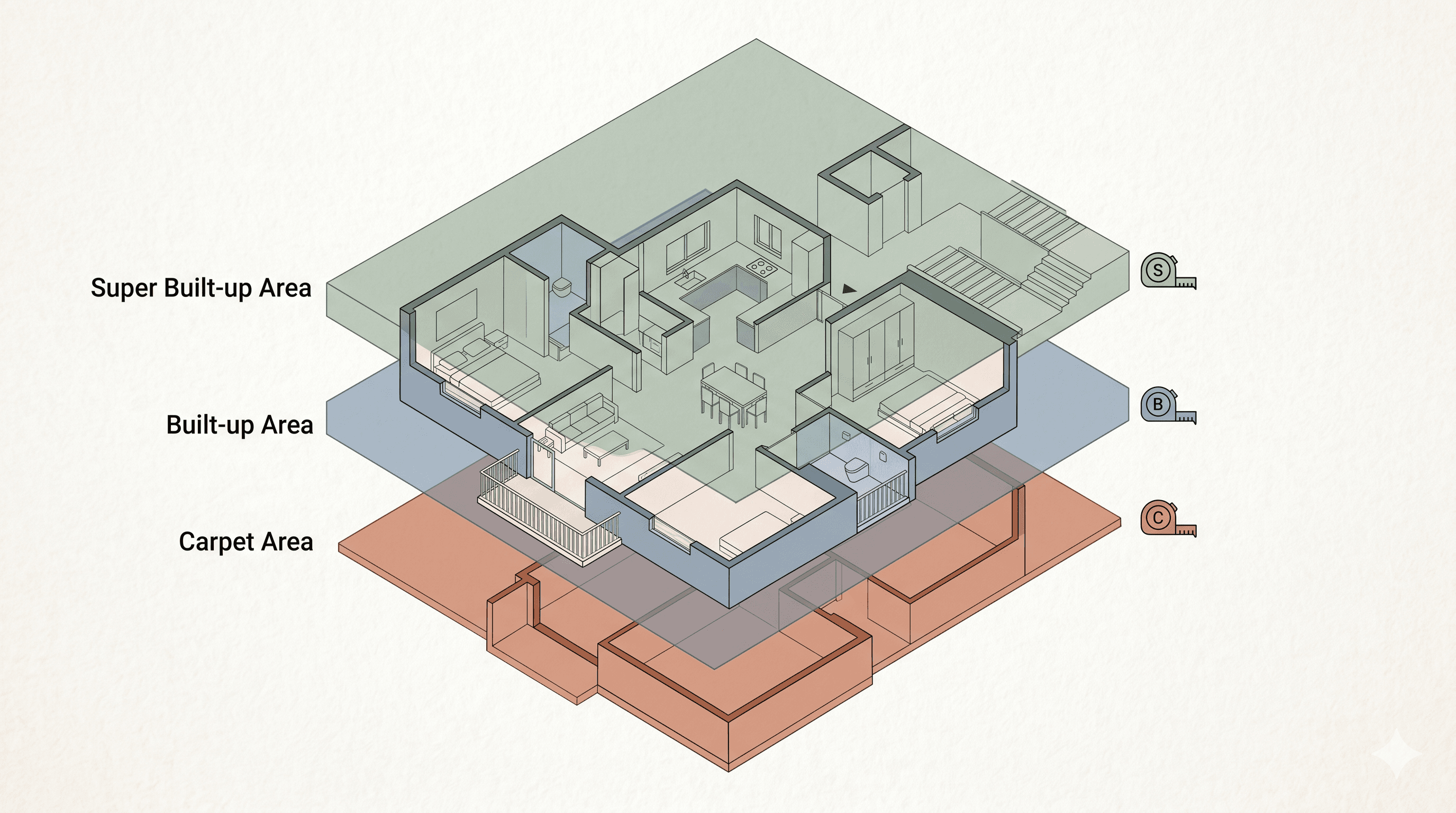
A "₹7,500 per sqft" flat almost never costs ₹7,500 per sqft. It costs whatever the builder has loaded on top of your actual usable floor — and that number, across NCR, ranges from 20% in old Indirapuram stock to a punishing 35% in new Noida towers. Once you run the maths properly, the cheapest sticker is often the most expensive flat in the shortlist, and vice versa.
This post is the short, honest version of a conversation we have with every first-time NCR buyer — with a worked example you can lift and reuse.
The three definitions, straight
Under RERA (Real Estate Regulation Act, 2016), these three terms now have precise definitions. Sales staff still blur them — the law does not.
Carpet Area
The net usable floor area within the walls of your flat — the area you could actually lay a carpet on.
- Excludes: external walls, service shafts, balconies, verandah, open terraces, exclusive or common areas outside the unit
- Includes: internal partition walls (inside-the-flat walls)
This is the number the RERA registration certificate records. This is the number your sale deed must state.
Built-Up Area
Carpet area plus the thickness of internal and external walls, plus balconies and utility ducts inside your unit's footprint.
- Typically 10-20% larger than carpet
- Useful for interior planning; not a pricing benchmark
Super Built-Up Area (SBA / saleable area)
Built-up plus your proportionate share of common areas — lobbies, staircases, lifts, clubhouse, gym, swimming pool deck, security cabins.
- Typically 20-35% larger than carpet
- This is the "loading" figure builders historically used to quote per-sqft prices
- Since RERA 2016, brochures and agreements must show carpet area; quoting only super built-up is non-compliant
The ₹10 lakh jargon trap — worked example
Here is the example we run with clients. Two flats in the same micro-market, same budget ballpark.
| Attribute | Flat A (slick brochure) | Flat B (honest broker) |
|---|---|---|
| Quoted size | 1,500 sqft super built-up | 1,154 sqft carpet |
| Quoted rate | ₹7,500 / sqft | ₹9,000 / sqft |
| Headline price | ₹1.125 Cr | ₹1.038 Cr |
| Loading factor | 30% | (carpet-quoted) |
| Actual carpet area | 1,154 sqft | 1,154 sqft |
| Real rate on carpet | ₹9,750 / sqft | ₹9,000 / sqft |
| Effective difference | — | ₹8.66 lakh cheaper |
Same usable space. Same floor area you actually live on. The "₹7,500 / sqft" flat costs ₹8.66 lakh more than the "₹9,000 / sqft" flat. That is the trap, in one table.
Now flip it — if Flat A really is a lower-loaded project (say 22%), then on 1,500 sqft super built-up you'd get 1,230 sqft carpet and the carpet rate drops to ₹9,150. Still slightly higher than Flat B, but no longer a disaster.
The single number that matters is the carpet rate. Not the super built-up rate. Not the headline. Calculate it before you get emotionally attached.
Loading factor — what it actually pays for
"Loading" is the builder's way of charging you for common infrastructure. Some of it is legitimate (lifts, staircases, lobbies, fire areas — you genuinely use them). Some of it is aspirational (the infinity pool, the cigar lounge, the yoga deck).
Typical NCR loading factors we see today:
| Segment / vintage | Typical loading |
|---|---|
| Older Indirapuram resale (Ahinsa Khand, Shakti Khand) | 25-28% |
| Mature Noida sectors (50, 74, 76, 78, 93A) | 28-32% |
| New Noida Expressway / Greater Noida West towers | 32-35% |
| Premium Gurugram / Dwarka Expressway high-rises | 33-38% |
| Boutique builder floors (Vasundhara, Vaishali, Kaushambi) | 15-22% |
Higher loading is not automatically bad. A 35% loading on a tower with a working 7,500 sqft clubhouse, two pools, three lifts per core, landscaped podium and an actual gym is paying for real usable amenity. A 35% loading on a project whose clubhouse is still "coming soon" three years after possession is a tax.
How RERA 2016 changed this
Before RERA, builders often wrote only super built-up on the sale deed. Buyers signed for 1,500 sqft, moved in, and discovered they had 1,050 sqft of carpet — 30% less than they thought.
Since 2016:
- The sale deed and agreement must state carpet area in the RERA-defined sense.
- Brochures and advertising material must mention carpet area.
- Post-handover variance is capped at ±3%. If you booked 1,200 sqft carpet and possession is handed over at 1,140 sqft (a 5% shortfall), you are entitled to a proportionate refund with interest — or to cancel and walk with a full refund plus delay compensation.
- The authority accepts complaints against builders who fail these disclosures.
This matters even on resale: the RERA-registered carpet area is on record at the state portal, and you can pull it up independently using the project's registration number (see our RERA verification guide for the step-by-step).
Questions to ask at every site visit
Print these. Ask them in order. Write down the answers.
- "What is the RERA-registered carpet area of this unit?"
- "What is the super built-up area, and what is the loading factor in percent?"
- "Can I see the RERA certificate and the approved floor plan?"
- "Is the per-sqft rate you quoted me on carpet or on super built-up?"
- "Will the sale deed and builder-buyer agreement state carpet area separately?"
If any of these questions produces visible discomfort, you have learnt something useful already. A compliant project answers all five without flinching.
Our playbook
- Always convert every shortlisted flat to a carpet-area per-sqft rate before comparing — do not let headline rates do the comparing.
- Loading above 32% only makes sense if the common amenity is visibly real and already delivered, not promised.
- Ask for the RERA carpet in writing; a WhatsApp message from the sales team is fine as evidence if it goes to the authority later.
- Re-check carpet at possession. The ±3% cap is enforceable — don't gift the builder a larger shortfall just to "close" the deal.
- If the project is a boutique builder floor or low-rise, loading will naturally be lower (15-22%) — factor this in honestly in the comparison.
The fastest way to de-risk this is to shortlist three or four flats and let us run a carpet-normalised comparison side by side. Our curated inventory is already priced on carpet internally; see the companion flat-buying checklist for the full pre-cheque workflow, and send us the options you're looking at — we'll tell you which one is actually the cheapest.