
Encumbrance Certificate & Title Search in UP 2026 — The 12-Year IGRSUP Download That Prevents a ₹1 Crore Disaster
Step-by-step 2026 guide to pulling a Barah Sala encumbrance certificate on IGRSUP, running a 30-year title search in Ghaziabad and Noida, and the red flags that catch bad deeds early.
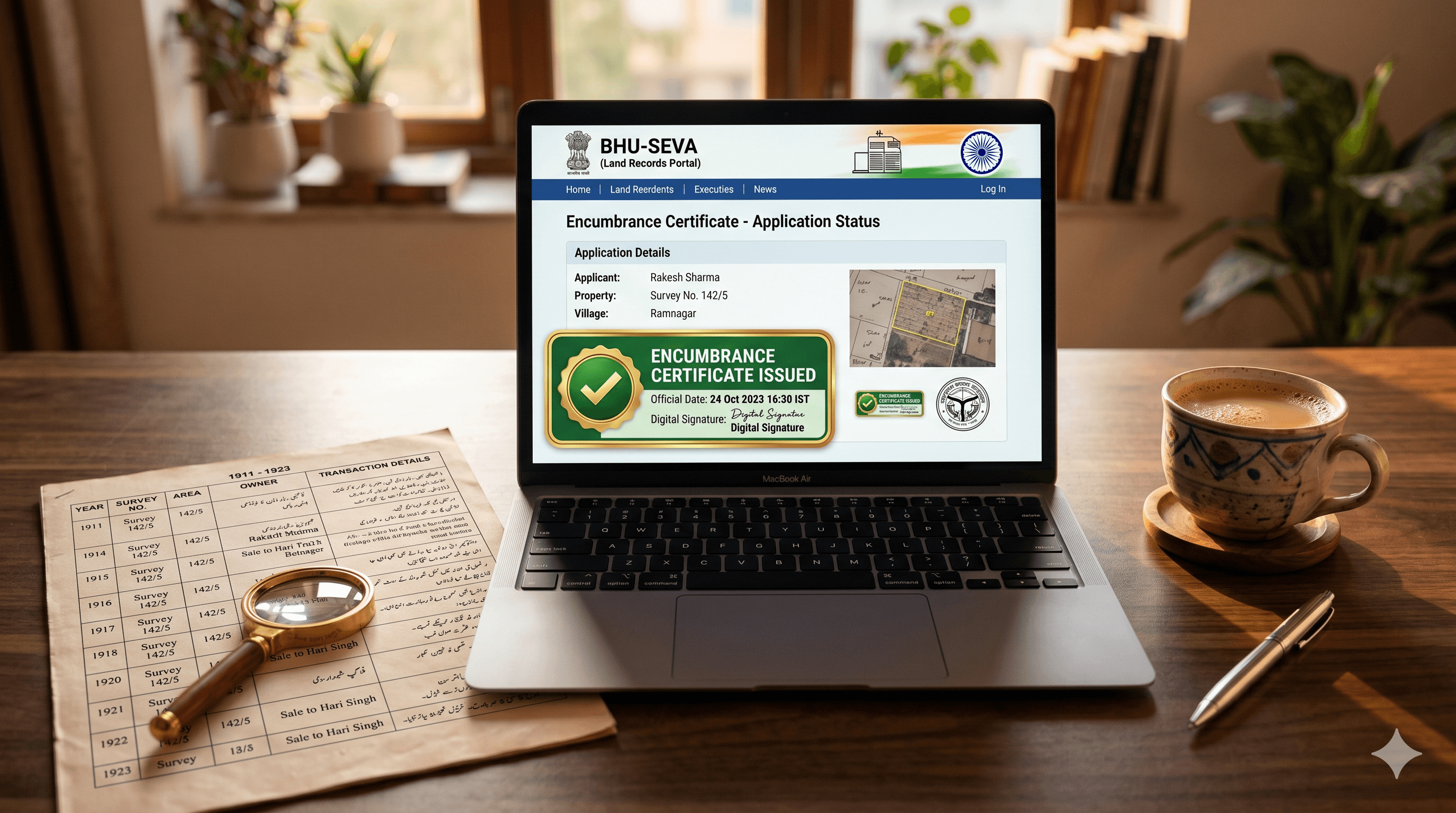
The single question every buyer should ask before handing over a cheque — "Is this property clean?" — has a narrow, boring, legal answer. It is called the Encumbrance Certificate, and in UP the 12-year version goes by a name most buyers never learn until there is a problem: the Barah Sala.
An EC tells you whether the flat or plot you're about to buy is genuinely free of mortgages, charges, liens, court attachments, or prior sales. It is the single cheapest piece of paper in the entire transaction — a few hundred rupees — and yet the one most first-time buyers skip because the sub-registrar's office looks intimidating. In 2026, you don't need to go there. The full process is online, digitally signed, and available from the comfort of your laptop. Here is how to run it yourself, and how to read what it tells you.
What an encumbrance certificate is (and isn't)
An EC is a statement issued by the sub-registrar's office listing every registered transaction on a property over a chosen period. Sale deeds, mortgage deeds, gift deeds, partition deeds, release deeds, lis pendens (pending-court-case references) — if it was registered, it shows up.
Two important limits to set expectations:
- An EC only reflects registered transactions. Oral agreements, unregistered powers of attorney, unregistered agreements to sell, family arrangements that were never formalised — none of these appear. A clean EC is necessary but not sufficient.
- An EC is not a title deed. It doesn't confirm the seller owns the property; it only confirms no registered encumbrance exists. You still need the chain of title deeds, the parent document, and a property lawyer's opinion on top.
Run on its own, an EC will prevent most retail fraud. Paired with a lawyer's title search, it prevents the complicated ones.
Barah Sala vs Tees Sala — 12 years or 30
UP's standard EC, called the Barah Sala (literally "twelve years"), covers the last 12 registered years of transaction history. That's the legal minimum most banks demand for home-loan sanction.
For high-value deals — a ₹2 Cr-plus apartment, a plot with multi-generational history, any property where the chain of ownership runs through more than one family — order a 30-year (Tees Sala) search. The cost difference is small (₹200 to ₹1,200 depending on duration) and the additional 18 years of visibility often surfaces old mortgages marked "open", partitions that were never closed, or gift deeds that were reversed.
Our standing advice at 9 Property Wala: Barah Sala for new-build flats, Tees Sala for resale or plots.
The IGRSUP process — step by step
The UP portal at igrsup.gov.in handles stamp-duty payment, deed pre-registration and encumbrance-certificate applications in one place. Here is the 2026 workflow:
- Open igrsup.gov.in. Use Chrome or Edge; the portal is occasionally flaky on Safari.
- Go to the "Bharmukta Pramanpatra / Barah Sala" tab on the home page (also listed as "Encumbrance Certificate" in the English menu).
- Login or register. First-time users create an account with PAN and Aadhaar-linked mobile. OTP-based login after.
- Fill the applicant details — name, PAN, father's name, address, contact — exactly as they appear on your ID proof.
- Fill the property details — district (e.g. Ghaziabad / Gautam Budh Nagar), tehsil, village or mohalla name, khasra or plot number, sector / block where relevant, flat number and tower name for apartments.
- Select the period — from and to date. For Barah Sala, select the past 12 years; for Tees Sala, past 30.
- Pay the fee — typically ₹200 to ₹500 for 12 years and up to ₹1,200 for 30 years. Payment is accepted via UPI, debit / credit card, or net banking.
- Submit the application. You receive an application reference number by SMS and email.
- Track status on the same portal. Most ECs are issued in 3 to 10 working days; complex urban properties can take longer.
- Download the digitally signed PDF. The SDCC (Sub-Divisional Cadastral Clerk) stamp is now a digital signature — no manual attestation needed; banks and registrars accept the signed PDF at par with physical copies.
If the system returns "No record found", two possibilities: either the property genuinely has no registered transactions in the period (unlikely for a resale) or your identifiers don't match the land records. Cross-check the khasra / plot number from the older sale deed before re-applying.
The Fehrist — UP's supplementary index
Alongside the EC, the Fehrist (Index) is a public search tool that lets you look up registered transactions by village name, khasra number, or party name. It doesn't show document details; it points you to the entries in the sub-registrar's register where full documents can be inspected.
For resale due diligence, pull a Fehrist search on the seller's name across the past 30 years. If the same seller has multiple entries you weren't told about — a mortgage, a partition suit, a prior sale — that is worth a conversation before you sign the token.
The SRO visit — when it still matters
Even with digital EC and Fehrist access, some due-diligence steps still benefit from a physical visit to the Sub-Registrar Office (SRO):
- Inspection of original registers — occasionally the digitised record has OCR errors; comparing the signed register resolves ambiguity
- Biometric appointment booking for the sale deed registration itself
- Deed-level inspection — reading the actual mortgage deed or partition deed referenced by the EC rather than just the one-line summary
- Lawyer's visit — your property lawyer will often pair a half-day SRO visit with the digital EC for their title report
Ghaziabad's main SROs are at the Collectorate complex; Noida / Greater Noida operate through the SRO offices at Sector 33 and the GNIDA building respectively. Avoid Friday afternoons and any date close to stamp-duty rate changes — queues triple.
How to read a Barah Sala — six red flags
A 12-year EC, printed out, runs 2 to 20 pages depending on property activity. Read it line by line with these red flags in mind:
1. Mortgage marked "open"
An older home-loan registration with no subsequent Release Deed or Deed of Reconveyance means the mortgage is still legally alive. Always demand the release deed before closing. Banks issue it within 30 days of loan closure; sellers who "forgot to apply" are sellers you chase for weeks.
2. Missing release deed after a closed loan
If the EC shows a mortgage "was" registered and the seller claims "loan closed 5 years back", but no release deed is on record — the charge is still on the property. The bank must issue and register a release deed before your sale can be clean.
3. Identical survey / khasra number registered twice
Sometimes land records carry overlapping entries where the same khasra is referenced in two separate sales. This can be innocuous (partitioned sub-numbers) or a red alert (double sale fraud). Investigate before you commit.
4. Pending civil suit reference (lis pendens)
Any reference like "suit no. XXX of 20XX" or "attachment by civil court" means litigation is live. Buying a property with a pending suit is buying into the suit itself. Walk away or wait for disposal.
5. Partition deed without closure
Plots that came through a family partition must show the partition deed registered and all co-sharers noted. If one sharer's name is missing from the partition but appears in an older title deed, you need that sharer's registered release before you buy.
6. POA-based sales in the chain
Any link in the 12-year chain executed by a power-of-attorney holder rather than the principal owner — even if the POA was registered — is fragile. The Supreme Court's 2011 ruling in Suraj Lamp v State of Haryana has made GPA-based property transfers legally brittle. Insist on a corrected chain or walk away.
What an EC does NOT protect against
Three categories of risk that a clean EC cannot reveal:
- Unregistered claims — oral family understandings, unregistered inheritance disputes, loans taken against the property without formal mortgage
- Tax arrears — municipal house tax, property tax in Noida / Delhi / Ghaziabad, water bills, society maintenance dues transfer to the new owner even if not mentioned in the EC
- Construction-law violations — unauthorised additional floors, missing occupancy certificates, structural departures from sanctioned plans. These require a separate architect / municipal verification
Pair your EC with: municipal tax paid-up certificate, society NOC (for apartments), latest electricity / water bill in seller's name, approved building plan and occupancy certificate (OC) from the development authority.
Property lawyer's title search — what you're paying for
A full title search by a property lawyer typically runs ₹10,000 to ₹40,000 depending on history, and includes:
- 30-year chain-of-title verification
- EC + Fehrist pull
- SRO physical register inspection
- Approved-plan / OC verification with the development authority
- Mutation status at the Nagar Nigam / development authority
- RERA status check — see our RERA verification for Delhi NCR guide
- Title opinion letter on the firm's letterhead
For a ₹1 Cr-plus purchase, skipping this fee to save ₹30,000 is the single worst risk-adjusted trade in the process. Reputable banks in any case demand a title opinion before loan sanction.
Common mistakes — the easy disasters to avoid
- Taking only the seller's word on "clean property". Seller affidavits are meaningless without registered proof.
- Skipping the 30-year search on a resale plot. Plots carry partition risk that flats typically don't.
- Accepting a "tentative" EC or a printed photocopy without the digital signature. Only the IGRSUP-issued digitally signed PDF is legally valid.
- Ignoring tax arrears. Arrears transfer with the property, not with the seller.
- Relying on the builder's lawyer. Get your own lawyer. The builder's lawyer works for the builder.
- Closing the deal before the release deed is registered. Close payment and registration on the same day the release deed is registered, not before.
- Missing mutation after registration. Once your sale deed is registered, apply for mutation (dakhil-kharij) at the Nagar Nigam / Authority within 30 days.
The 7-day due-diligence checklist
- Day 1: Barah Sala EC pulled from IGRSUP; ₹200-500 fee
- Day 2: Fehrist search on seller's name across 30 years
- Day 3: Property lawyer engaged; parent deed and chain-of-title shared
- Day 4: SRO visit by lawyer for deed-level inspection
- Day 5: Municipal tax-paid certificate + society NOC collected
- Day 6: RERA status, OC, approved plan verified with the development authority
- Day 7: Title opinion letter received; go / no-go decision
If you want us to order a full EC and title search package on a specific Ghaziabad or Noida property, including lawyer's title opinion and the 30-year Fehrist search, call us or send a brief. We'll come back with the digitally signed EC, title report and red-flag summary within 48 hours.
— Team 9 Property Wala