
Stamp Duty & Registration in UP, Delhi and Haryana 2026 — The ₹4-Lakh Gender and State-Line Savings Every NCR Buyer Overlooks
Complete 2026 guide to stamp duty and registration in Ghaziabad, Noida, Delhi and Gurgaon — women-buyer concessions, joint ownership rules, circle-rate traps and how to save up to ₹4 L legally.
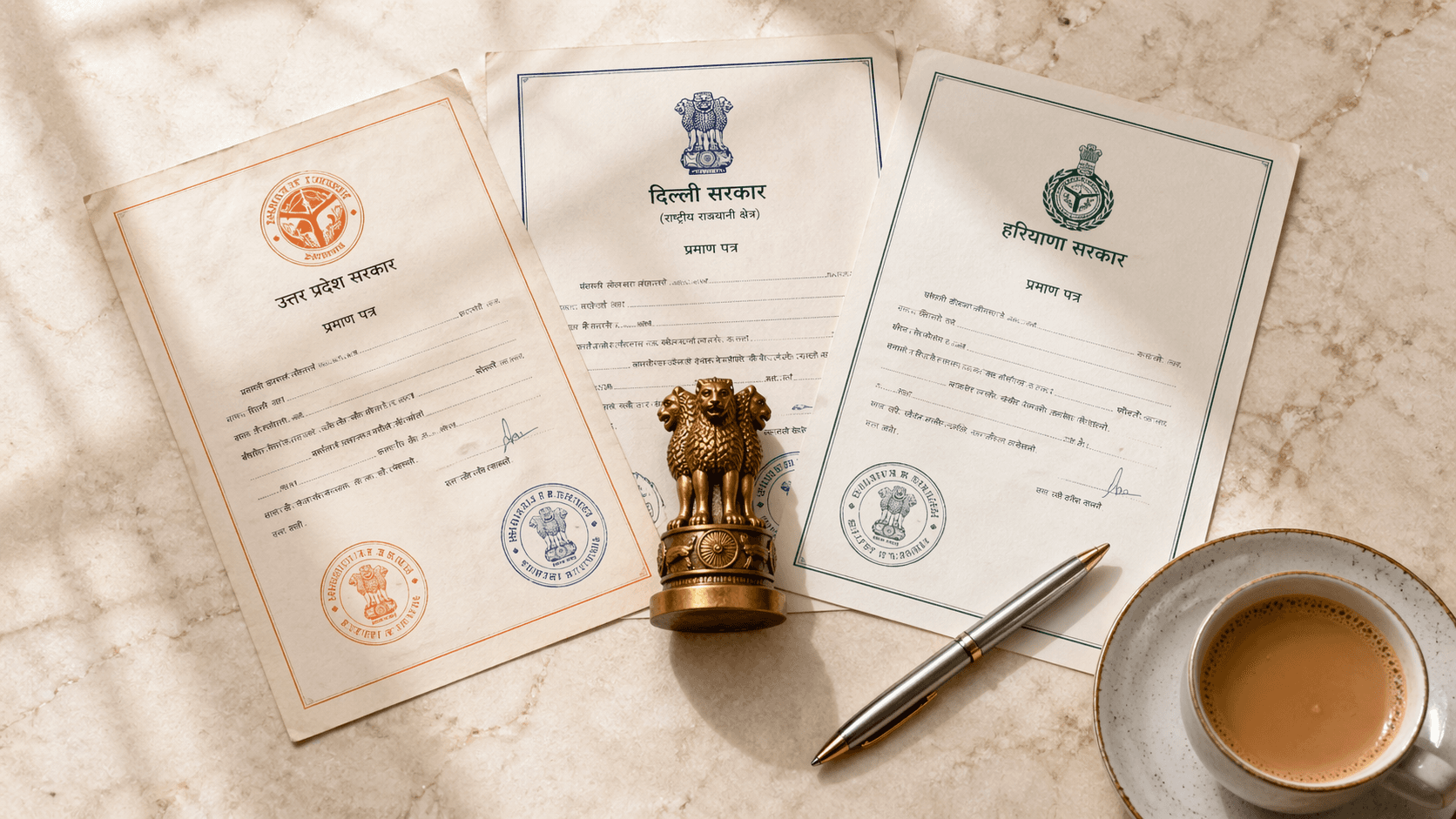
Most NCR buyers pick a flat, fix a loan, then are casually told "stamp duty and registration — budget around 7 to 8%, sir" three days before execution. That's when a ₹1 Cr flat suddenly becomes ₹1.08 Cr, and the "we'll handle the paperwork" arrangement quietly costs ₹2 to ₹4 lakh more than it had to.
The three states that meet at NCR — Uttar Pradesh, Delhi and Haryana — each write their own stamp-duty schedules. Which side of the state line your flat sits on, whose name the sale deed goes into, and whether the circle rate is higher than your transaction value can together move the final invoice by lakhs. Here is the 2026 picture, state by state, for a working NCR buyer.
The 2026 rate card — Uttar Pradesh, Delhi, Haryana
Uttar Pradesh (Ghaziabad, Noida, Greater Noida)
- Men (sole owner): 7% stamp duty + 1% registration
- Women (sole owner): 6% stamp duty up to ₹1 Cr transaction / circle rate, 7% on amounts above ₹1 Cr; 1% registration
- Joint ownership (any combination): 7% stamp duty + 1% registration
- The women concession applies when the woman is the first named holder on the sale deed — not merely a joint holder listed second
Delhi (NCT of Delhi)
- Men (sole owner): 6% stamp duty + 1% registration
- Women (sole owner): 4% stamp duty + 1% registration
- Joint men + women: 5% stamp duty + 1% registration
- Delhi's 2% spread for women is the widest gender concession in NCR and applies without the ₹1 Cr ceiling that caps UP
Haryana — urban municipal limits (Gurgaon, Faridabad)
- Men (sole owner): 7% stamp duty + 1% registration (min ₹1,000)
- Women (sole owner): 5% stamp duty + 1% registration
- Joint ownership: 6% stamp duty + 1% registration
Haryana — rural / outside municipal limits
- Men: 5% + 1% registration
- Women: 3% + 1% registration
- Joint: 4% + 1% registration
One important footnote: in Haryana, the women-buyer concession applies only when the property is registered solely in a woman's name. A joint deed with a husband listed alongside drops you to the 6% joint slab even if she is the first holder.
The ₹4-lakh gender arithmetic nobody shows you
Picture a ₹1 Cr ready-to-move flat bought by a working couple. Same flat, same price, three states:
| Scenario | Ghaziabad / Noida (UP) | Delhi | Gurgaon (Haryana urban) |
|---|---|---|---|
| Sole owner — husband | ₹7 L + ₹1 L = ₹8 L | ₹6 L + ₹1 L = ₹7 L | ₹7 L + ₹1 L = ₹8 L |
| Sole owner — wife | ₹6 L + ₹1 L = ₹7 L | ₹4 L + ₹1 L = ₹5 L | ₹5 L + ₹1 L = ₹6 L |
| Joint (husband + wife) | ₹7 L + ₹1 L = ₹8 L | ₹5 L + ₹1 L = ₹6 L | ₹6 L + ₹1 L = ₹7 L |
The widest legal saving is a sole-female Delhi buy — ₹5 L vs ₹8 L for a sole-male Gurgaon buy on the same ticket. That is ₹3 L of state-line arbitrage on a ₹1 Cr flat. Stretch it to a ₹1.5 Cr ticket and the delta pushes past ₹4 L.
A quick honesty check — the only reason to register a flat solely in the spouse's name is that she genuinely holds the equity. Bogus benami arrangements to chase the concession are a separate, criminal problem under the Benami Transactions (Prohibition) Amendment Act.
Joint ownership — when it still makes sense
Even though joint ownership rarely beats sole-female on stamp duty alone, three considerations push many buyers back into joint:
- Home-loan eligibility — two earning co-applicants typically unlock 30 to 40% more sanction than one. See home loan eligibility for NCR first-time buyers for the full breakdown.
- Section 80C and 24(b) deductions double when both spouses are co-borrowers AND co-owners — up to ₹1.5 L each under 80C and ₹2 L each under Section 24(b) for self-occupied property, subject to their actual contribution.
- Succession and nomination — the surviving spouse inherits smoothly without a probate drag.
Run the arithmetic both ways before fixing the deed. Saving ₹1 L on stamp duty but losing ₹60,000/year in tax deductions is a bad trade over a 20-year loan tenure.
Circle rate vs transaction value — the trap most buyers miss
Stamp duty is paid on circle rate or transaction value, whichever is higher. This is where resale buyers in undervalued Ghaziabad pockets get stung. Two specific situations to know:
- UP circle rates in Ghaziabad are under a proposed ~40% revision for FY 2026-27. If your deal closes before the revised notification, lock in at the older circle rate. After the notification, the same transaction value pushes you into a higher duty bracket.
- If transaction value is below circle rate — say a ₹75 L resale in a pocket where circle rate is ₹85 L — you still pay stamp duty on ₹85 L and the ₹10 L gap can be deemed "additional income" under Section 56(2)(x) of the Income Tax Act for the buyer. Always check the circle rate before signing the token.
Every state publishes circle rates online — UP at igrsup.gov.in, Delhi on the revenue department site, Haryana via jamabandi.nic.in. Check yours at the token stage, not at the registrar's office.
Delhi property-tax quarters — a separate line item
Delhi MCD property tax runs on quarterly due dates (April, July, October, January) and offers a 10% rebate if the full year is paid before 31 July. Don't confuse this with the one-time stamp duty — it's an annual recurring charge under the unit-area method based on colony category (A to H) and covered area. Full details in our upcoming property tax in Ghaziabad, Noida and Delhi 2026 guide.
Ghaziabad separately cleared a 5% annual house-tax increment for FY 2026-27, which shows up on your Nagar Nigam bill, not the sale deed. If you're a first-time NCR owner, budget both.
What else you pay at registration
Beyond stamp duty and registration, the sub-registrar office collects a handful of smaller charges that add 0.3 to 0.8% to the invoice:
- Deed writing / legal scribe fee: ₹5,000 to ₹25,000 depending on complexity
- TDS on property: 1% deducted by buyer if seller is resident and property value exceeds ₹50 L (Section 194-IA of the Income Tax Act)
- Biometric / e-stamp service charges: ₹500 to ₹1,500
- Mutation / dakhil-kharij (transferring the name in municipal records after registration): ₹1,000 to ₹5,000
Factor these in. They are small per line, but collectively cross ₹30,000 on a ₹1 Cr deal.
Step-by-step — registering a property in UP
- Pre-registration: obtain the encumbrance certificate (Barah Sala), verify chain of title, check RERA status — see RERA verification for Delhi NCR
- E-stamp paper: purchase from SHCIL or authorised vendor for the stamp duty amount, or pay online via igrsup.gov.in
- Deed drafting: a property lawyer or authorised deed-writer drafts the sale deed with PAN, Aadhaar, photograph, and exact schedule of property
- Appointment at Sub-Registrar Office (SRO): book online; buyer, seller, two witnesses attend with original IDs
- Biometric capture: fingerprints + photograph captured; deed presented
- Registration: SRO endorses the deed, issues a digitally signed copy, updates the Fehrist (public index)
- Mutation: within 30 days, apply at the municipal body (Nagar Nigam Ghaziabad / Noida Authority / GNIDA) to transfer the name in their records
Red flags — what not to do
- Never pay stamp duty short to "adjust" against a lower notional sale price. Post-2023 data sharing between registrar, income-tax and GST means the under-declaration gets flagged within months, and the penalty is up to 10x.
- Don't register at a rural sub-registrar for an urban property even if the vendor offers a "faster slot". Jurisdiction is territorial; a deed registered at the wrong SRO can be challenged as defective.
- Don't skip the biometric appearance. Power-of-attorney registrations for someone else's signature are a legal nightmare unless the POA itself is registered and notarised to the letter.
- Don't accept "unregistered agreement to sell" + possession. Section 17(1) of the Registration Act, 1908 makes registration of sale deeds compulsory for immovable property above ₹100. An unregistered deed is inadmissible as evidence of ownership.
- Don't forget the mutation. Until mutation is done, electricity and water bills still reach the previous owner — and on resale, buyers will pause on a mismatched name.
The 48-hour checklist before registration day
- Circle rate confirmed for the exact sector / village / colony
- Stamp duty calculated on the higher of circle rate or transaction value
- Women-buyer concession eligibility verified against the deed structure
- E-stamp paper or online payment receipt ready
- EC + 12-year chain of title reviewed
- Two witnesses with PAN + Aadhaar confirmed
- Mutation forms kept ready for submission within 30 days
- TDS on property (1%) deducted and Form 26QB filed if sale value exceeds ₹50 L
If you want a clean stamp-duty estimate on a specific property, or a side-by-side comparison of solo-female vs joint registration for your exact loan structure, call us or send a brief. We'll come back with a two-page worksheet mapping your stamp duty, registration, mutation and TDS across all three state scenarios within 48 hours.
— Team 9 Property Wala